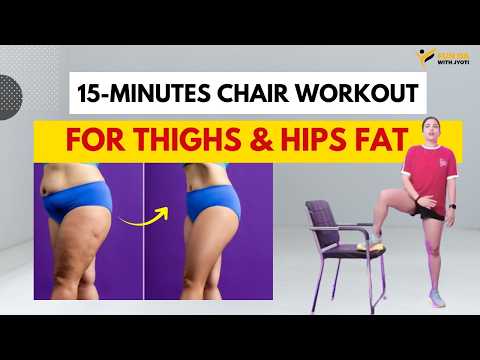
A chair workout is one of the easiest ways to start exercising at home. The chair supports you, so you can control every move, protect your knees and back, and still work hard enough to feel it. This 15-minute routine works all the major muscle groups: legs, hips, back, chest, shoulders, arms and core.
Before you start
- Choose the right chair: sturdy, four legs, no wheels and no swivel. Push it against a wall so it cannot slide.
- Check with your doctor first if you haven’t exercised for some time, or have a health condition, as the NHS advises.
- Wear comfortable clothes and supportive shoes, or work barefoot on a non-slip floor. Keep water nearby.
- Had a baby recently? Get your doctor’s go-ahead and start with our DR-safe trim tummy workout.
How the 15 minutes work
- Warm-up: 2 minutes.
- Main workout: six moves, each for 40 seconds with 20 seconds’ rest. Do the six moves once, then repeat them for a second round. That is 12 minutes.
- Cool-down: 1 minute.
Work at a level where you can still talk but not sing: the NHS “talk test” for moderate activity. Use a phone timer, or simply count 15 slow repetitions per move.
Warm-up (2 minutes)
- Sitting tall, march your feet and swing your arms: 30 seconds.
- Shoulder rolls, then big arm circles: 30 seconds.
- Stand and step side to side, reaching your arms overhead: 1 minute.
The six chair moves
1. Chair squat (thighs and hips)
Stand in front of the chair, feet hip-width apart. Push your hips back and lower until you lightly touch the seat, then stand up through your heels. Keep your chest up and knees in line with your toes.
Easier: sit down fully and use your hands on your thighs to stand. Harder: hover just above the seat for a second before standing.
2. Seated fast knee lifts (cardio and core)
Sit near the front of the chair, hold the sides of the seat and lean back slightly with a tall spine. Lift your knees one after the other at a brisk pace, as if running while seated, pumping your arms if you can.
Easier: march slowly. Harder: stand behind the chair, hold the backrest and do standing knee lifts.
3. Chair push-up (chest, shoulders and arms)
With the chair against the wall, place your hands on the front edge of the seat. Step your feet back until your body makes a straight line. Bend your elbows to lower your chest towards the seat, then push back up.
Easier: do push-ups against the wall instead. Harder: slow down, taking three seconds to lower.
4. Supported reverse lunge (legs and balance)
Stand beside the chair with one hand on the backrest. Step one foot back and bend both knees a little, keeping your front knee over your ankle, then step back to standing. Do 20 seconds on each leg.
Easier: take a smaller step and bend less. Harder: hold a water bottle in your free hand.
5. Seated twist with a bottle (core and waist)
Sit tall without leaning on the backrest, holding a water bottle at chest height with both hands. Turn your upper body slowly to one side and back to the centre, then to the other side, keeping your hips still and breathing out as you turn.
Easier: no bottle, arms crossed on your chest. Harder: lean back slightly as you twist.
6. Standing calf raise with a squeeze (calves, buttocks and posture)
Stand behind the chair holding the backrest. Rise onto your toes while squeezing your buttocks, pause, and lower slowly.
Easier: hold on with both hands. Harder: do it on one leg at a time.
Cool-down (1 minute)
Sit down. Stretch your thighs by straightening one leg with the heel on the floor and leaning forward gently, then stretch your chest by clasping your hands behind the chair. Hold each stretch for about 20 seconds and breathe slowly.
A simple weekly plan
- Monday, Wednesday and Friday: the 15-minute chair workout.
- Tuesday, Thursday and Saturday: 20 to 30 minutes of brisk walking or dancing to your favourite songs.
- Sunday: rest, or a gentle walk.
This builds towards WHO’s advice for adults: 150 to 300 minutes of moderate activity a week, plus strength exercises on at least 2 days. On busy days, even one round is worth doing: WHO is clear that some activity is better than none.
How to progress over the weeks
- Add a third round.
- Work for 45 seconds and rest for 15.
- Hold filled water bottles for squats, lunges and calf raises.
- Swap to the harder version of one move at a time.
Ready for more? Focus on one area with our lower body workout and upper body workout, or follow the 4-week beginner plan.
Stop and get advice if
- you feel chest pain, dizziness, or breathlessness that doesn’t settle with rest
- you feel sharp pain in a joint, rather than the normal effort of working muscles
- a knee or back problem gets worse after exercise. Our knee pain guide has gentler options.
Follow along with Dr. Jyoti
Prefer to be guided? Dr. Jyoti’s 15-minute chair workout and chair workout for thighs and hips are below, and our home workouts page has more free follow-along videos. Chair workouts are a regular part of FunDa classes because they suit every age and fitness level.
Sources
- Bull FC et al. World Health Organization 2020 guidelines on physical activity and sedentary behaviour. Br J Sports Med. 2020.
- NHS. Physical activity guidelines for adults aged 19 to 64 (reviewed 22 May 2024).
- World Health Organization. Physical activity, fact sheet (26 June 2024).
How we write our guides: read our editorial and evidence policy.