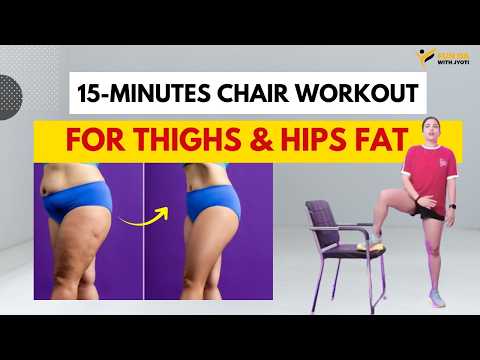
Thighs and hips get slimmer with whole-body fat loss, and firmer and stronger with lower body strength training. You need both. Leg exercises alone don’t burn the fat over your thighs, but combined with good food and daily movement, they shape your lower body and make everyday life easier: stairs, getting up from the floor, long walks.
Why you can’t spot-reduce thigh fat
Training one body part doesn’t burn the fat on top of it. When researchers had 104 adults train one arm for 12 weeks, MRI scans showed fat loss spread across the body rather than concentrated in the trained arm. The same principle applies to thighs and hips.
Many women store more fat on the hips and thighs, and it is often the last place to change. That is normal. What works is the whole picture: balanced home meals (see our Indian diet guide), daily walking or dance, strength training for the whole body and enough sleep.
Why lower body strength matters
- Your legs and hips are the biggest muscles in your body, so training them uses a lot of energy.
- Strong hips and thighs support your knees and lower back.
- Inactive adults lose about 3 to 8% of their muscle mass per decade, and strength training is how you keep it. Leg strength is what keeps you getting up from the floor and climbing stairs easily as you age.
What you need
A sturdy chair against a wall, a step or the bottom stair, and two filled water bottles for later weeks. Warm up for 3 minutes first: march on the spot, do gentle side steps and swing each leg forward and back while holding the chair.
The eight lower body moves
1. Chair squat (thighs and buttocks)
Stand in front of the chair, feet hip-width apart. Push your hips back and lower until you lightly touch the seat, then stand up through your heels, squeezing your buttocks at the top. Keep your knees in line with your toes.
2. Supported reverse lunge (thighs and balance)
Hold the chair back with one hand. Step one foot back and bend both knees, keeping the front knee over the ankle, then push through the front heel to stand. Do all repetitions on one side, then switch.
3. Glute bridge (buttocks and back of the thighs)
Lie on your back with knees bent and feet flat. Breathe out and lift your hips until your body makes a straight line from shoulders to knees, squeeze your buttocks, then lower slowly.
4. Side-lying leg lift (outer hips)
Lie on your side with your bottom knee bent for balance. Lift your top leg, keeping it straight and slightly behind you with toes pointing forward, then lower slowly. Do both sides.
5. Standing kickback (buttocks)
Hold the chair back and stand tall. Keeping your leg straight, push one foot back and up a little, squeezing your buttock, without arching your lower back. Return and repeat, then switch legs.
6. Step-up (thighs and buttocks)
Using the bottom stair or a sturdy low step, with a wall or rail to hold, step up with one foot, press through that heel to bring the other foot up, then step down slowly. Lead with the same leg for all repetitions, then switch.
7. Calf raise (calves and ankles)
Hold the chair back, rise onto your toes, pause and lower slowly.
8. Wall sit (thighs)
Lean your back against a wall and slide down until your knees are slightly bent, then hold for 15 to 30 seconds, breathing normally. Only go as low as is comfortable for your knees.
Sets, repetitions and a weekly plan
- Start with 2 sets of 10 to 12 repetitions of each move (each side for one-leg moves), resting about a minute between sets.
- Build up to 3 sets of 12 to 15 repetitions, then hold water bottles for squats, lunges and step-ups.
- Twice or three times a week, on non-consecutive days, alongside our upper body workout. WHO recommends strength work for all major muscle groups on at least 2 days a week.
- On other days: brisk walking or dance cardio, building up to 150 to 300 minutes of moderate activity a week.
Kind to your knees
- Add a cushion to the chair so you don’t squat as deep.
- Take shorter lunge steps, or swap lunges for more glute bridges.
- Skip the step-up and wall sit until your knees feel ready.
- Mild effort is fine; sharp pain, swelling or locking is not. Our knee pain guide has more joint-friendly moves.
Common mistakes
- Knees caving inwards during squats and lunges: keep them in line with your toes.
- Only doing leg exercises. Train your whole body and keep moving through the day.
- Rushing. Slow, controlled repetitions work the muscles better than fast ones.
- Weighing yourself daily. Measure your hips and thighs once a month instead.
How FunDa helps
The Lower Body Transformation program includes a live lower body session with Dr. Jyoti every week, chair-supported, low-impact moves, dance cardio and personalised nutrition for whole-body fat loss. New to exercise? Start with our 15-minute chair workout. Results vary from person to person.
Sources
- Kostek MA et al. Subcutaneous fat alterations resulting from an upper-body resistance training program. Med Sci Sports Exerc. 2007;39(7):1177-85.
- Bull FC et al. World Health Organization 2020 guidelines on physical activity and sedentary behaviour. Br J Sports Med. 2020.
- NHS. Physical activity guidelines for adults aged 19 to 64 (reviewed 22 May 2024).
- Westcott WL. Resistance training is medicine: effects of strength training on health. Curr Sports Med Rep. 2012;11(4):209-16.
How we write our guides: read our editorial and evidence policy.